Tuesday, 1 January 2013

Bob Mondello's Best Movies Of 2012

Cousin Ben (Jason Schwartzman), Sam (Jared Gilman) and Suzy (Kara Hayward) show that nothing can stand in the way of young love in Wes Anderson's Moonrise Kingdom.

Cousin Ben (Jason Schwartzman), Sam (Jared Gilman) and Suzy (Kara Hayward) show that nothing can stand in the way of young love in Wes Anderson's Moonrise Kingdom.

Niko Tavernise/Focus Features

A lot of movie box-office records fell in 2012. The comic-book blockbuster The Avengers had the biggest opening weekend in Hollywood history. Skyfall will be the first James Bond film to top $1 billion worldwide. And the box-office year as a whole is easily the movie industry's biggest ever. But what about quality? Perhaps surprisingly, the news is good there, too.

Hollywood is often accused of serving up simple-minded pleasures — either explosions or uplift, frequently both — but a lot of this year's best films were nuanced and complex, and for once, their nuanced complexity was exactly what made them popular. Steven Spielberg's Lincoln, for instance, is no wide-eyed presidential snow job, but a tale of political intrigue where the great good of eradicating slavery requires great compromise on lesser evils. The film has other virtues — terrific performances, gorgeous cinematography — but what's captivating audiences is that it's not the dipped-in-amber civics lesson they expected.

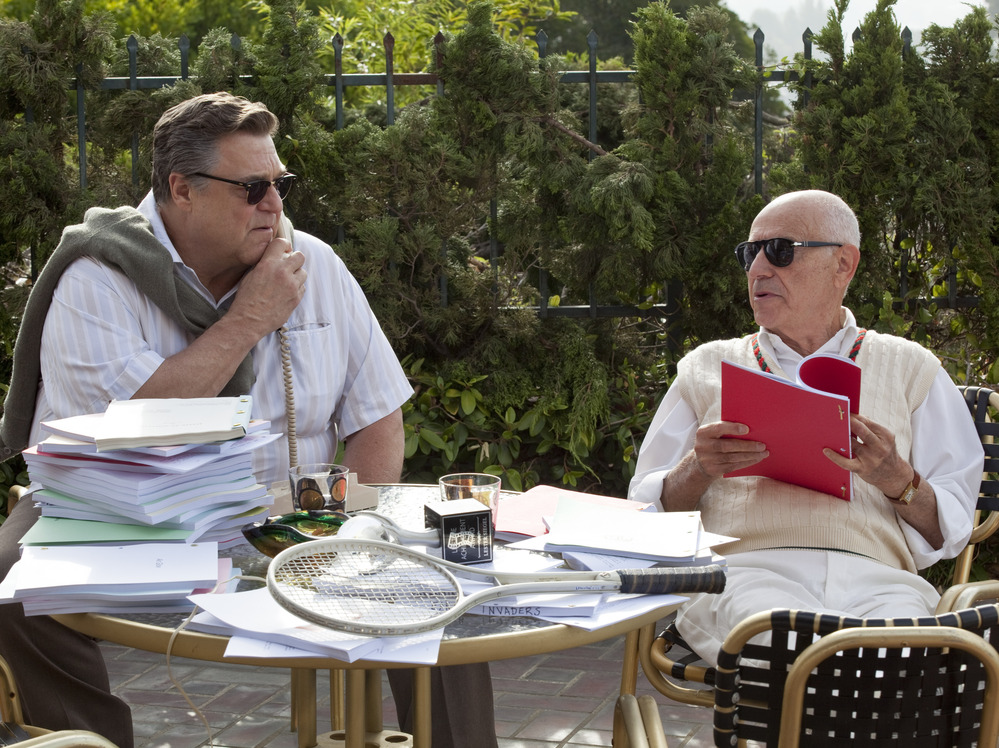
John Chambers (John Goodman) and Lester Siegel (Alan Arkin) help craft a fake movie production in Argo.

Claire Folger/Warner Bros. John Chambers (John Goodman) and Lester Siegel (Alan Arkin) help craft a fake movie production in Argo. John Chambers (John Goodman) and Lester Siegel (Alan Arkin) help craft a fake movie production in Argo.
Claire Folger/Warner Bros.

That's also true of the war-on-terrorism chronicle Zero Dark Thirty, a gritty look at the hunt for Osama bin Laden that raises all sorts of moral and ethical questions, and is about as far from a rah-rah, get-the-bad-guy flick as director Kathryn Bigelow could make it.

That's a good thing, because Ben Affleck made a rah-rah, get-away-from-the-bad-guys flick that would be pretty hard to top: the rousing thriller Argo, about how the CIA got six Americans out of Tehran during the Iran hostage crisis by pretending to make a movie.

That's a trio of fact-based stories. Beasts of the Southern Wild, in contrast, is a fable that blends real-world tempests and mythical creatures in telling the tale of a 6-year-old girl named Hushpuppy who lives in a bayou community, hit by a hurricane. Filled with danger, but also warmth, Hushpuppy's world is at once real and magical — as is the movie.

The next three of the year's most compelling pictures hail from overseas. France gives us Michael Haneke's devastating masterwork Amour, about an elderly married couple, played by the great French stars Jean Louis Trintignant and Emmanuelle Riva, who find themselves facing the end of life. It's not a pretty end to a love that's lasted decades, but they find joy while they can in things like a brand new motorized wheelchair.

Another French picture, Rust and Bone, is about a love just beginning — between a fighter and a woman who suffers a life-altering accident — one that required some of the year's most arresting special effects.

2012's most compelling documentary, meanwhile, hails from Israel: The Gatekeepers, in which six former heads of Israel's internal security service, Shin Bet, talk about everything from targeted assassinations to being hung out to dry by the politicians who gave them their marching orders. Augmented by news footage, the film offers an alternately fascinating and deeply upsetting perspective on conflict in the Middle East.

Also eye-opening is a far lighter documentary about a 1970s folk singer from Detroit who gave up music after cutting an album that got no traction in the U.S. Unbeknownst to him, it sold like hot cakes in South Africa, where all his fans thought he'd died, until someone went Searching for Sugar Man.

That's eight of my top 10. The last two are by directors named Anderson. Moonrise Kingdom is Wes Anderson's whimsical look at a small New England community's reaction when a 12-year-old orphan who excels at scouting runs off camping with a girlfriend.

That contrasts with the high seriousness Paul Thomas Anderson brings to his midcentury epic, The Master, about a movement called The Cause, its charismatic leader (Philip Seymour Hoffman), and an alcoholic acolyte (Joaquin Phoenix). The film is as intense psychologically as it is ravishing visually.

OK, that's a Top 10, so theoretically, we're done, but the number 10 feels especially arbitrary in a terrific year like this one, so let's keep going. Commercial filmmakers came up with some seriously cool fantasies this year, including two co-starring Joseph Gordon Levitt — the time-travel thrill ride Looper, in which Gordon-Levitt is an assassin who must kill his future self (played by Bruce Willis), and the final episode in Christopher Nolan's Batman trilogy, The Dark Knight Rises, in which he's intent on saving children and orphans.

That's a theme that has a particular resonance as 2012 draws to a close, and that was also present in two foreign films earlier in the year — Monsieur Lazhar, about a sensitive substitute teacher from the Middle East, who helps traumatized students deal with their former teacher's suicide at a Canadian primary school; and the Dardenne brothers' The Kid With a Bike, about an abandoned Belgian child and the woman who tames his violent impulses.

Impulse control also figures in two compelling love stories: Keep the Lights On, Ira Sachs' film a clef about a gay love affair undone by drug use; and Silver Linings Playbook, David O. Russell's far happier tale about two damaged, bipolar souls who are heavily medicated.

Another romance steeped in jazz was the year's loveliest animated film — Chico and Rita, a conventionally drawn, unconventionally adult tale of Cuban musicians who come to the U.S. in the 1940s and '50s. And Tim Burton's black and white, stop-motion spoof Frankenweenie was also pretty splendid — the story of a boy who reanimates his dog, Sparky, after an auto accident.

That title's obviously a riff on Frankenstein, which is not the only classic novel to triumph in an unorthodox reworking this year. Leo Tolstoy's Anna Karenina was vividly reimagined as if taking place literally in a theater, with spoiled Russian aristocrats walking from interiors that are clearly stage sets into the wings, where snow is falling and the real world beckons.

And just as Anna's leapt from page to stage, leaping from the stage to the screen is the musical of Victor Hugo's Les Miserables, with the actors singing on-camera, which proves effective enough that you wonder why they don't do it all the time. Les Miz is not for all tastes, perhaps, but it's catnip for a theater nut like me.

That's a second 10, and if pressed, I could probably even come up with a third. It's been that kind of year: rewarding enough to send film lovers into cineplexes in 2013 feeling downright optimistic.


View the original article here

Why We Toast: Uncorking A New Year's Tradition

A happy-looking 1930s couple toasts.

A happy-looking 1930s couple toasts.

Fox Photos/Getty Images

The act of toasting feels natural: You lift your arms in affirmation and drink in honor of an occasion or a loved one.

It's what millions will do this week as they ring in the New Year, but why? Like shaking hands or saluting, toasting is a habit with incredibly foggy beginnings, so we here at The Salt decided to dig into it, for the sake of science.

"There's a thin line between history and folklore," says historian Paul Dickson. He should know. He wrote a book about toasting called Toasts: Over 1,500 of the Best Toasts, Sentiments, Blessings and Graces. "But toasting definitely goes back to the ancient world."

Ulysses drank to the health of Achilles in The Odyssey, he says. And in Rome, drinking to someone's health was so important that the Senate demanded that all diners drink to their emperor, Augustus, before every meal.

Almost every culture — the Hebrews, Egyptians, Persians, Saxons, Huns — had a pledging of honor with a glass, Dickson says.

But it wasn't always called a toast. The term didn't come about until the late 17th century. In the same way you throw a lime in tequila, it was customary to plop a piece of toast or crouton in a drink, Dickson says. Think of it as an early form of a cocktail snack.

"It may have been a flavoring device," he says. "The practice was common, and virtually anything found floating in a drink was referred to as toast."

Origins Of The 'Clink'

And the clinking of glasses? Dickson says that toasting flair didn't popularize until the early days of Christianity.

Many believed the bell-like noise would drive off the devil — which was most dangerous in times of drinking and reveling. But that's just one theory.

Another legend contends that by adding the clink, toasters could get the greatest pleasure from a drink, Dickson says. Before the clink, toasts only satisfied four of the five senses.

And there's a third theory.

Though Dickson's research can't confirm or deny this one, many believe the clinking of glasses began as a way for nobles to avoid being poisoned. The tale goes that the clank would slosh liquid from one drink to the other, reassuring the guest that his or her drink was safe and untouched.

The Road To The American Toast

Regardless of the reason, many in those early days drank to health, hospitality and honor. But every culture practiced different customs — some a bit strange. The Irish tended to recite blessings, whereas young Englishmen in the 17th century toasted sour drinks to profess their love.

"The practice called for men to show their affection for a woman by stabbing themselves in the arm, mixing their blood in their wine, and drinking to the lady in question," Dickson explains.

In Scotland, it was customary to drink sparingly during the meal and then bring in a large punch bowl filled with whiskey, hot water and sugar after dinner. The drinking sometimes lasted eight to 10 hours, Dickson says.

And as for early Americans — they adopted the tradition of toasting quite readily. But their ritual was largely directed to America as a patriotic gesture. They toasted to the new republic and the experiment of democracy.

"After the [Revolutionary] War, no official dinner or celebration was complete without 13 toasts, one for each state," writes Dickson. "For many years, the 13 toasts were obligatory at local Fourth of July celebrations."

Today, the ritual of toasting seems more popular than ever, perhaps a product of movies and cultural references, Dickson says.

Toasts have also evolved into something of a verbal souvenir: "It's something you take home with you as sort of a remembrance of that time."

We'll certainly do that on Monday night.


View the original article here

Why Black Men Tend To Be Fashion Kings

Tell Me More intern Azmi Abusam is dressed in designs by Guess, Aldo and H&M. He got his handmade leather bag from a street dealer in Khartoum, Sudan. Abusam says his style changes every six months, but it's usually based on comfort, quality and personal taste. Hide caption Tell Me More intern Azmi Abusam is dressed in designs by Guess, Aldo and H&M. He got his handmade leather bag from a street dealer in Khartoum, Sudan. Abusam says his style changes every six months, but it's usually based on comfort, quality and personal taste. NPR Washington Desk Assistant Editor Brakkton Booker. Hide caption NPR Washington Desk Assistant Editor Brakkton Booker. NPR Digital Media's Matt Thompson shows off a plum-colored Express shirt with a lavender DKNY silk tie, charcoal wool vest by Indochino and wool pants by Calvin Klein. He says he keeps things simple for the most part, usually wearing muted colors with one bold accent. Hide caption NPR Digital Media's Matt Thompson shows off a plum-colored Express shirt with a lavender DKNY silk tie, charcoal wool vest by Indochino and wool pants by Calvin Klein. He says he keeps things simple for the most part, usually wearing muted colors with one bold accent. Tell Me More's Barbershop guy Jimi Izrael wears a Kenneth Cole shirt, Inc jacket and Ray Ban glasses. He says he mostly has his wife's taste in clothes, but also likes unconventional takes on conventional clothing items. Hide caption Tell Me More's Barbershop guy Jimi Izrael wears a Kenneth Cole shirt, Inc jacket and Ray Ban glasses. He says he mostly has his wife's taste in clothes, but also likes unconventional takes on conventional clothing items. Hide caption Kevin Langley of NPR's Operations team dresses in a navy blue pin-striped Calvin Klein suit. Made of cashmere, wool and polyester, the suit has an athletic fit. Langley says his overall style is "business attire," and he's drawn to ties that look expensive and professional, but are cheap and accentuate his shirt or suit. Republican strategist Ron Christie wears a tailored three-piece suit from Lord Willy's in New York City. He says the style is bespoke British with irreverent flair. And when Christie isn't dressed for business, he turns to casual Lucky Brand jeans and a sweater. Hide caption Republican strategist Ron Christie wears a tailored three-piece suit from Lord Willy's in New York City. He says the style is bespoke British with irreverent flair. And when Christie isn't dressed for business, he turns to casual Lucky Brand jeans and a sweater. Hide caption Victor Holliday, associate producer of NPR's on-air fundraising, wears a light gray wool suit (DKNY Essentials) under a black vintage overcoat with fine English stitching (Regis Rex). He considers his style "easy elegance." Hide caption NPR Senior Producer Walter Watson pairs his blue Banana Republic sweater with golden brown Lands' End slacks. He calls his style "nothing too fancy office casual wear." Tell Me More's Barbershop and political chat contributor Corey Ealons is outfitted in a Joseph Abboud black velvet jacket with a ticket pocket and pink silk handkerchief. Ealons says real men can wear pink with confidence, and that his style is classic and clean with a little edge. Hide caption Tell Me More's Barbershop and political chat contributor Corey Ealons is outfitted in a Joseph Abboud black velvet jacket with a ticket pocket and pink silk handkerchief. Ealons says real men can wear pink with confidence, and that his style is classic and clean with a little edge. Maxwell Ealons, 4, enjoys dressing like his father, Corey. His dressy clothes usually come from Children's Place, H&M, Target and Zara. He actually dresses himself for school with Spider-Man, Batman and Redskins shirts, plus jeans or sweat pants. Hide caption Maxwell Ealons, 4, enjoys dressing like his father, Corey. His dressy clothes usually come from Children's Place, H&M, Target and Zara. He actually dresses himself for school with Spider-Man, Batman and Redskins shirts, plus jeans or sweat pants.

For many, style is much deeper than articles of clothing; it's a statement of identity. Black men have a unique relationship with fashion, one that can be traced all the way back to the 17th and 18th centuries.

Monica L. Miller, the author of Slaves to Fashion: Black Dandyism and the Styling of Black Diasporic Identity, spoke with Tell Me More's Michel Martin about the past, present and future of black men's fashion.

Miller, an associate professor of English at Barnard College, explains that African-American men have used style as a way to challenge stereotypes about who they are. "Sometimes the well-dressed black man coming down the street is asking you to look and think."

Victor Holliday, associate producer of on-air fundraising at NPR and one of the resident kings of style, tells Martin that he learned about the importance of fashion at an early age. "When I was 5 years old, I knew exactly how I was going to look," he says. "And that was the year I got my first trench coat and my top hat."

Holliday's style icon is his father, who taught him that the main object of dressing up is winning respect. "Because as you present yourself seriously, people tend to take you seriously."

Holliday is one of the men featured in Tell Me More's Kings of Style slideshow.


View the original article here

Close Out The Year With Some Best-Selling Last Words

A stack of books. iStockphoto.com

People often make lists of the greatest opening lines in fiction, but closing lines really appeal to me. They're your final moments with a book and can help you remember and treasure it forever.

The last weekend of the year seems an appropriate time to consider the final words of our favorite novels and short stories. Here are some that I'm especially fond of:

NPR librarian Kee Malesky has been dubbed "the source of all human knowledge" by NPR's Scott Simon. The author of the books All Facts Considered and Learn Something New Every Day: 365 Facts to Fulfill Your Life, she shares her adventures from the reference desk in this series called Kee Facts.

The Great Gatsby
F. Scott Fitzgerald
"So we beat on, boats against the current, borne back ceaselessly into the past."

Middlemarch
George Eliot
"But the effect of her being on those around her was incalculably diffusive, for the growing good of the world is partly dependent on unhistoric acts, and that things are not so ill with you and me as they might have been is half owing to the number who lived faithfully a hidden life and rest in unvisited tombs."

Still Life With Woodpecker
Tom Robbins
"But I can and will remind you of two of the most important facts I know: (1) Everything is part of it. (2) It's never too late to have a happy childhood."

The Good Earth
Pearl Buck
"'Rest assured, our father, rest assured. The land is not to be sold.' But over the old man's head they looked at each other and smiled."

The Dharma Bums
Jack Kerouac
"Then I added 'Blah,' with a little grin, because I knew that shack and that mountain would understand what that meant, and turned and went on down the trail back to this world."

Angela's Ashes
Frank McCourt
"I stand on the deck with the Wireless Officer looking at the lights of America twinkling. He says, 'My God, that was a lovely night, Frank. Isn't this a great country altogether?' 'Tis.'"

The Haunting of Hill House
Shirley Jackson
"Within, walls continued upright, bricks met neatly, floors were firm, and doors were sensibly shut; silence lay steadily against the wood and stone of Hill House, and whatever walked there, walked alone."

The Dead
James Joyce
"His soul swooned slowly as he heard the snow falling faintly through the universe and faintly falling, like the descent of their last end, upon all the living and the dead."

The Silence of the Lambs
Thomas Harris
"But the face on the pillow, rosy in the firelight, is certainly that of Clarice Starling, and she sleeps deeply, sweetly, in the silence of the lambs."

The World According to Garp
John Irving
"In the world according to her father, Jenny Garp knew, we must have energy. Her famous grandmother, Jenny Fields, once thought of us as Externals, Vital Organs, Absentees, and Goners. But in the world according to Garp, we are all terminal cases." (Note: John Irving has told interviewers that he always writes the last lines of his novels first.)

What last lines would you share from your favorite books? Please add yours to the comments section below.


View the original article here

The Fiscal Cliff: A Love Story

America, if you're scared by all the talk you've been hearing about the fiscal cliff, take heart: There are reasons for people across the political spectrum to love the cliff.

There's a lot for liberals to like in the fiscal cliff, says Matthew Yglesias, who writes wonky articles about economics for Slate.

Take the spending cuts. Entitlement programs like Social Security and Medicaid that liberals generally support are left unaffected, while a large share of the cuts fall on the military, which many liberals would be happy to reduce anyway.

The combination of tax hikes and spending cuts could eventually send the country into recession. But that probably won't happen, Yglesias says, because at some point in the next few weeks Congress will probably agree on a compromise.

That's partly because going off the cliff will let Congress sell a tax increase as a tax cut. Simon Johnson, an economist at MIT, walked me through how that works.

A big part of the fiscal cliff is the expiration of temporary tax cuts. So, for example, the 33 percent tax bracket will rise to 36 percent on Jan. 1.

Say you think the ideal rate for income in this bracket should be higher than 33 percent. Say you think it should be 34 percent. On Monday, Dec. 31, 34 percent is a tax increase. On Tuesday, Jan. 1, it's a tax cut.

Conservatives who worry that the government is borrowing too much money should love the cliff for a simple reason: It will cut the deficit.

The federal government spends over $3.5 trillion every year — on health care for the elderly, drones for the military, bridges, etc. But the government only brings $2.5 trillion in tax revenue. We borrow the remaining $1 trillion, and we're going to have to pay it back eventually.

Going over the cliff — paying more taxes and getting fewer government services — means we borrow less. By the same token, it forces the country to pay up front for a bigger share of the government services we're consuming.

"It forces taxpayers to realize what they're paying, and I think that's a good thing," Russ Roberts, a libertarian economist at Stanford's Hoover Institution, told me.


View the original article here

Is The Party Over For The Tea Party?

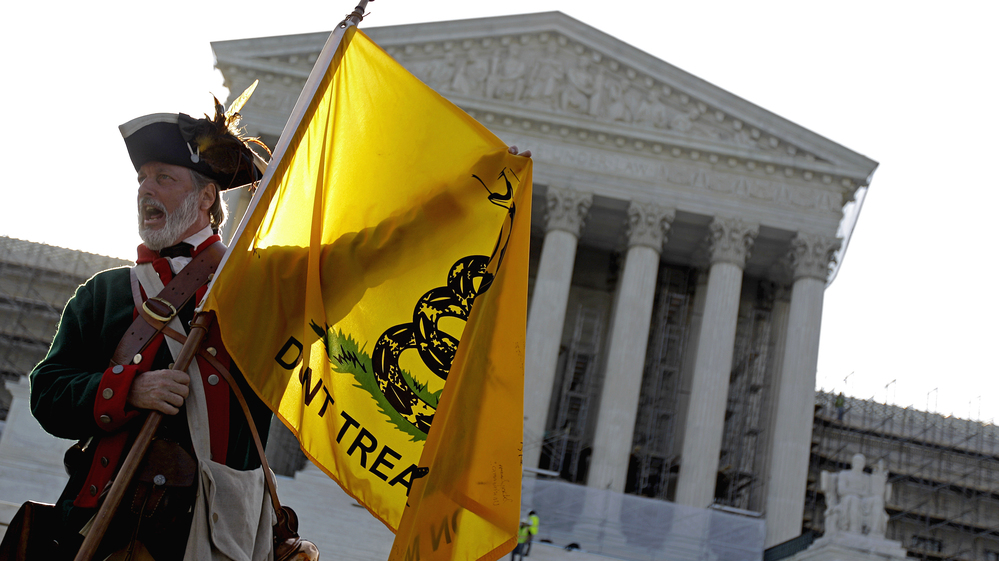
Tea Party supporter William Temple of Brunswick, Ga., protested outside the Supreme Court in June as justices debated the constitutionality of President Obama's health care law.

David Goldman/AP Tea Party supporter William Temple of Brunswick, Ga., protested outside the Supreme Court in June as justices debated the constitutionality of President Obama's health care law. Tea Party supporter William Temple of Brunswick, Ga., protested outside the Supreme Court in June as justices debated the constitutionality of President Obama's health care law.

David Goldman/AP

It's a little bit early, but the Tea Party is hitting its sophomore slump.

A few of the prominent members of Congress elected as part of the Tea Party wave in 2010 lost their seats in November. With the end-of-year budget negotiations going nowhere, the Tea Party has been described variously as standing on the sidelines and losing its clout.

"We could end up with taxes going up for everybody and Republicans getting the blame, which from the standpoint of the Tea Party is the worst of all possible outcomes," says Jack Pitney, a government professor at Claremont McKenna College in California.

One group closely aligned with the Tea Party, FreedomWorks, suffered a near-meltdown this summer, with a power struggle leading to the ouster of its chair, Dick Armey, a former House majority leader.

Putting aside the difficulties of the present moment, members of Congress associated with the Tea Party face a larger question. Like other large classes elected in the past, they're finding that it's easier to talk about changing Washington than actually doing it.

In the coming year, the returning members will have to decide whether they want to continue practicing a politics of purity, advocating strong and unyielding positions, or accept that governance generally requires a good deal of compromise.

"Being part of a governing majority is recognizing that you often have to settle for an imperfect outcome," Pitney says.

Purity Vs. Pragmatism

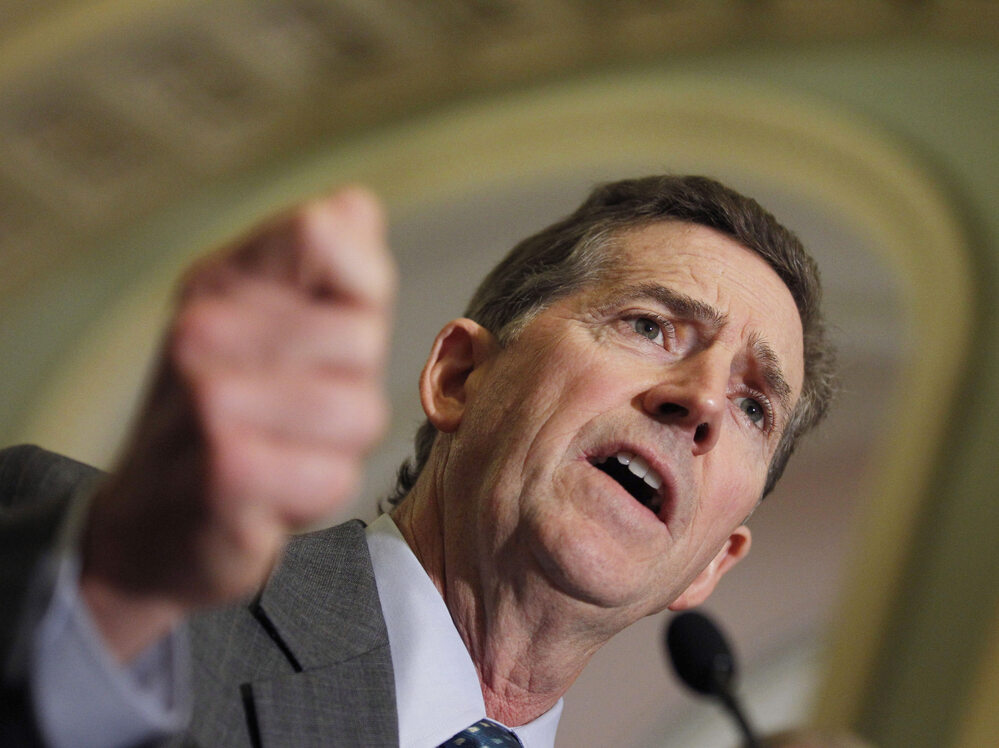
South Carolina's Jim DeMint announced earlier this month that he will resign his U.S. Senate seat to run the conservative Heritage Foundation.

Alex Brandon/AP South Carolina's Jim DeMint announced earlier this month that he will resign his U.S. Senate seat to run the conservative Heritage Foundation. South Carolina's Jim DeMint announced earlier this month that he will resign his U.S. Senate seat to run the conservative Heritage Foundation.

Alex Brandon/AP

South Carolina GOP Sen. Jim DeMint, one of the brightest lights associated with the Tea Party, opted to play a more purely advocacy role earlier this month, giving up his seat to run the conservative Heritage Foundation.

DeMint once said he'd rather be part of a minority of "rock-ribbed conservatives" in the Senate than a mushier majority. Some political observers and even Republican senators have said DeMint's wish was his command, with his support of ideologically pure primary candidates who lost winnable seats helping cost the GOP its chances for Senate majorities in both 2010 and 2012.

Such support of staunch conservatives has been good for the party, argues Barney Keller, spokesman for the Club for Growth, a fiscally conservative group that has also played a prominent role in GOP primary battles.

He notes that DeMint stood nearly alone when he first came to the Senate, but his ideological banner has since been taken up by a number of free-market-oriented senators. "We view the election of the next generation of Jim DeMints as of paramount importance to the future of the country," Keller says.

Hard Knocks For Mr. Smiths

Each of the large classes elected to Congress in recent decades has come to Washington with some message of renewed purity, from the "Watergate babies" of 1974 through the Republicans elected on Ronald Reagan's coattails in 1980 to the "Republican revolution" that took over Congress in 1994.

"The liberals who came in after the 1974 elections, they weren't for compromise, either," says Donald Ritchie, the Senate's official historian.

All these large classes were elected in reaction to something, usually the perceived failures of a president. That was certainly the case in 2010, when the GOP was able to take advantage of unhappiness about President Obama's handling of the economy and his health care law.

But all of them found that there's a great difference between being on the outside and complaining about government's failures to becoming part of the government and coming up with workable solutions. That was certainly the case with the Class of 1994, which paid a political price for insisting on a budget approach that led to a government shutdown at the end of its first year in power.

The Tea Party has found that there are all kinds of tripwires built into the American system of checks and balances that prevent newcomers from quickly remaking the political culture into their own image.

"The Tea Party has definitely peaked," says Linda Killian, a senior scholar at the Wilson Center. "It was successful in motivating Republicans to move to the right to get themselves nominated, but when it comes to governing it's an entirely different matter."

Even Republicans more sympathetic to their Tea Party brethren say they are still in the process of finding that it takes time to translate principles into policy — particularly when an ideological enemy has just been re-elected to the presidency.

"Republicans have had a problem for 20 years with that, moving from advocacy to governance," says Lewis Gould, a historian of the GOP. "They have some questions about whether they're willing to make the compromises, the choices and accept the imperfect nature of the government, or are they always to want to have the perfection of advocacy."

The Primary Challenge

Several departing Republicans have decried the no-compromise style of their younger colleagues in recent weeks, "a bunch of extremists that can't even get a majority of our own people to support the policies we're putting forward," as retiring Rep. Steve LaTourette of Ohio put it after the abortive House vote on a tax proposal last week.

"Too often in recent years, members of Congress have locked themselves into a slate of inflexible positions, many of which have no hope of being implemented in a divided government," Indiana Sen. Richard Lugar said in his farewell address this month. "It is possible to be re-elected and gain prominence in the Senate while giving very little thought to governance."

Lugar lost his bid for re-election this year when he was defeated in the GOP primary by Richard Mourdock, a Tea Party favorite who went on to lose in November. Lugar's defeat has been taken as yet another sign that Republicans have to worry about political challenges in primaries if they deign to compromise.

"Pure parties are minority parties," says Bill Connelly, a political scientist at Washington and Lee University in Virginia. "If the Tea Party stalwarts want to continue to nominate the Mourdocks instead of the Lugars, they'll remain a pure, minority party."

Winning Isn't Everything

For political parties, winning elections is the most important possible outcome. But it's not always what advocacy groups such as the Club for Growth (or its counterparts on the left) care most about.

They may want to promote ideas that they believe can and should prevail over the long term, rather than cutting corners to win immediate electoral victories.

"The role of the club is to be uncompromising on these issues," Keller says. "The No. 1 thing that motivates members of Congress, more than anything, is the fear of losing their jobs, and that's where our PAC and superPAC come in."

While it's true that the role of advocacy and research groups such as FreedomWorks, the Club for Growth and the Heritage Foundation is to push as strong a position as possible, it's up to members of Congress to sort through the various opinions that are out there and come up with legislation that can appeal, given divided control, to a majority of both parties.

That's a tall order these days, and not just for the Tea Party. But an aversion to deal-making and a desire to reshape Washington are part of the movement's DNA.

The relative newness of the Tea Party, combined with its generally skeptical attitude toward government, has made the usual challenges of turning reaction against existing policies into a passable agenda that much more difficult.

"The Tea Party people face a choice," says Gould. "You can be a maverick in Congress and have a lot of press but not be part of the action, or you can be part of the action and face a primary challenge for having gone Washington."


View the original article here

Another Year And I'm Still Here: A New Year's Meditation

Look at yourself. Right now.

You are muscle,skin, bone, brain, blood, warmed by energy, and all of you, every cell, even the subsets of those cells, all trillions and trillions of them, are going to tire, waste and depart. In 10 years almost every bit of you will have been replaced by new bits.

And yet, you will still be you. You will look like you do (sort of), you will behave like you do (sort of), others will know it's you (most of the time), and though a census of your innards will say, this is a new body, a different collection of atoms, you will know it's the same old you. How come?

If you are all new on the inside, how do you persist?

What Keeps Us Whole?

Well, there's your soul. If this weren't a sciencey blog, we could stop here. Your soul, breathed into you at your conception, will hang around till it's time to go and then be off to wherever it is souls go to. But suppose you are a "materialist"? Suppose you choose to imagine this journey naked, you as just a bunch of atoms, nothing added? What holds a soulless soul together?

The answer, these days, is your brain. Your memory. It's the story you tell yourself as you grow up, the unfurling narrative that begins with faces and smells and meals and sounds, then stretches into tales about your mom, dad, siblings, your pets, your family, your friends. It deepens with loves, joys, disappointments. It is always told by you, filtered through you. You are the one who tells it, you are the one who hears it, you are the only one who knows every bit of it.

Memories Are Our Duct Tape

To a significant degree, you are the sum of the stories you tell yourself about yourself.

Take away your memories, the connective tissue of your life, and what's left? You may be breathing, but in the late stages of memory loss, you aren't really there any more. You have unraveled.

We live this life together, but we experience it alone.

And when you actually die, what is annihilated? Well, there are tens of thousands of private images in your head right now: the pigeon you once almost caught when you were 4. The sight of a particularly beautiful girl disappearing through a doorway. The brief whoosh made by a snowy owl flying low that time you were walking alone in the woods. These are things no one knows, no one ever knew, no one but you.

When you go, they go. Forever. But as long as you're here, they stay. So, to all those pigeons, those girls, those owls that live in our heads, as long as we're here — to all of you, and to us, Happy New Year!


View the original article here